The Building Environment CO₂ (BECO₂) Use Case is designed to address a pressing challenge in the real estate sector: collecting and reporting reliable, standardized, and verifiable Scope 3 emissions data. These emissions—indirect emissions that occur in a company’s value chain—are now increasingly subject to regulatory scrutiny under frameworks such as the Corporate Sustainability Reporting Directive (CSRD), EU Sustainable Finance Disclosure Regulation (SFDR), EU Taxonomy, and IFRS S2. For real estate owners, this poses a particular challenge due to the wide range of outsourced services and fragmented data sources that contribute to building-related emissions.

Use case objective
Emission data (related to building maintenance and operations) is generated continuously along the (real estate) supply chain. This supply chain also functions as a data value chain, involving multiple actors (such as service providers, material suppliers, real estate owners, and reporting tools). While relevant emissions data exists at different points in this chain, it is often fragmented, exchanged manually, or not structured in a way that allows it to be reliably reused for reporting and decision-making.
The objective of the BECO₂ (Building Environment CO₂) Use Case is to test how this situation can be improved through standardised, automated, and secure data exchange within the Green Deal Data Space (GDDS). The use case focuses on enabling the collection, validation, and consumption of primary Scope 3 emissions data across selected points of the data value chain, particularly where data exchange takes place between real estate owners and their service and maintenance providers. The scope of this use case in the project phase is Finland real estate sector.
The BECO₂ trial aims to demonstrate how Scope 3 emissions data can be shared in a traceable, interoperable, and legally compliant manner by also applying trust and interoperability mechanisms, harmonised data models, and API connectors. The overarching objective is to support automated, accurate, and standardised Scope 3 emissions reporting in the real estate sector, in alignment with regulatory requirements, as well as internal sustainability management and commercial decision-making.
The GHG protocol defines the methods for calculating emissions. Since the quality of input data varies in practice, GHG also offers different levels of options, from an accurate actuals-based model to a less accurate euro-based calculation, and everything in between. Within the GDDS, a data model is defined that makes emission data calculated in different ways more comparable.
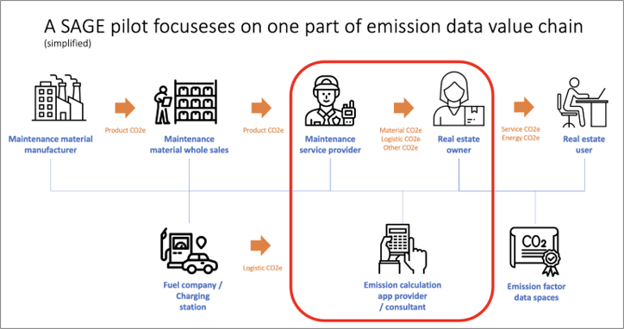
Fig. 1. An emission data value chain
End users and stakeholders
The participating organisations represent the following roles:
- Construction/building material wholesale
- Building maintenance companies
- Real estate owners – use the data for reporting, benchmarking, and decision-making.
- Emission calculation consultants – use raw emission data to calculate Scope 3 emissions.
- Emission calculation application providers – use the data to provide tools and services to real estate owners or consultants.
Some of these end users are being identified and selected in collaboration with Rakli (The Finnish Property Owners’ Industry Association).
The SAGE project team is looking for additional participants, including real estate owners, building maintenance service providers, and building material wholesalers, as well as CO2 calculation consultants who are interested in contributing to a European-wide emission reporting solution.
Tech providers play a central role in digitalising emissions reporting for real estate maintenance. By integrating secure data sharing, metadata standards, and trust mechanisms, they facilitate more reliable and scalable Scope 3 emissions monitoring. This not only strengthens ESG compliance but also positions the sector for sustainable innovation in line with European climate goals.
Objectives/Benefits
Benefits
- Optimising the Data Collection Process
- Streamline emission data collection from multiple service providers through a unified process.
- Transition from manual data sharing to automated solutions.
- Enhancing Data Quality
- Establish data models that include metadata for data quality assessment.
- Improve data transparency and reliability.
- Standardised and Comparable Reporting
- Enable standardised emissions reporting across the real estate industry within the GHG (Greenhouse Gas) Protocol.
- Development of industry-wide data models for real estate maintenance.
- Facilitate benchmarking solutions for performance comparison.
Objectives
- Improve Data Interoperability: Introduce harmonised emission data models (JSON-LD) for accurate, consistent reporting.
- Automate Data Exchange:Enable API-based data submission, enriched with metadata, using the iSHARE-compliant Identification & Access Management (see more here).
- Ensure Compliance: Support CSRD, ESRS, IFRS, and SFDR alignment through traceable and auditable data flows.
- Enhance Trust & Access Control: Implement role-based identity verification and secure, logged data access for third parties.
- Drive Innovation in ESG Reporting: Foster a data-driven sustainability culture within the real estate sector.
- Create new business opportunities: Companies can develop more accurate customer-specific emission calculation services and offer them at a European level.
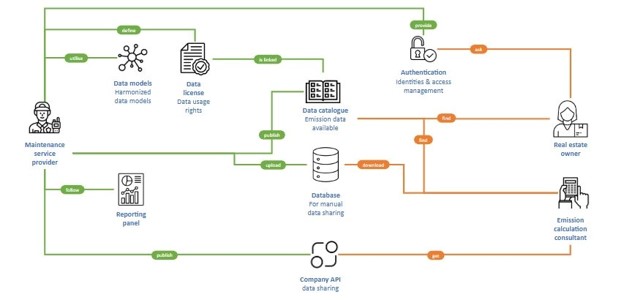
Fig. 2. A process example of Scenario 1 based on GDDS
Partners/Participants
| Partner | Logo | Country |
|---|---|---|
| STICHTING ISHAREFOUNDATION |  | NL |
| KATALYSTI OY |  | FI |
Expected results
In a target stage, data will flow across the entire value chain with multiple stakeholders in such a way that Scope 3 emissions per real estate asset can be calculated in a standardised and comparable manner. This is achievable even if companies use different calculation methods, data models, or have varying levels of maturity.
At the Process Level:
- Reduction in data aggregation time: Automation will reduce data processing times by over 60%.
- Improved accuracy: Real-time and verified data reduces human error and model inaccuracy.
- Streamlined verification: Digital authorisation and provenance logs enable faster audits.
At the Business Level:
- Compliance readiness: The organisation will meet regulatory demands more efficiently.
- Operational savings: Reduced administrative overhead through automation.
- Improved ESG image: Reliable Scope 3 reporting strengthens investor and tenant confidence.
- Benchmarking: Harmonised data supports comparison across buildings and partners.
Contact
- Boróka Péter, iSHARE Foundation, boroka@ishare.eu
- Vesa Ilmarinen, Katalysti, vesa.ilmarinen@katalysti.fi
- Vinith Bhandari, iSHARE Foundation, vinith@ishare.eu